- Published on
SEO vs. GEO vs. AIO: What the Acronym War Means for Your Brand
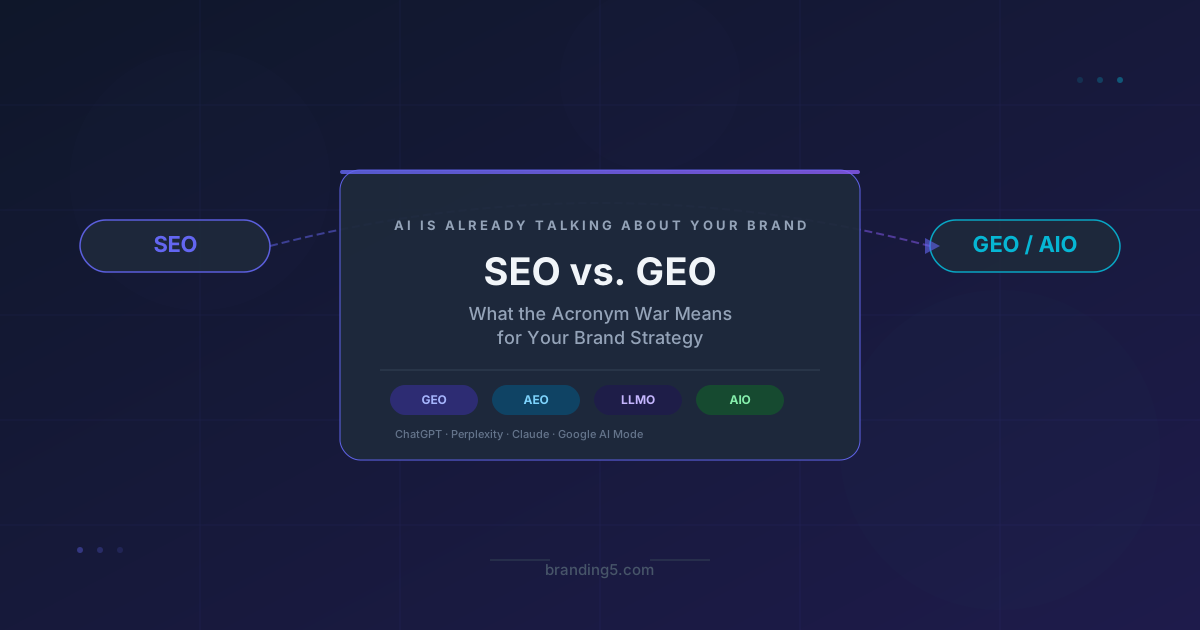
Open any marketing newsletter right now and you'll be hit with a tidal wave of new acronyms: GEO (Generative Engine Optimization), AEO (Answer Engine Optimization), LLMO (Large Language Model Optimization), AIO (Artificial Intelligence Optimization). Each one arrives breathlessly, as if it's a completely new discipline that makes everything you knew obsolete.
Here's the truth: they all mean essentially the same thing. They're different lenses on one emerging shift: optimizing for AI systems that don't just rank your content, but synthesize, cite, and recommend it.
The fundamentals of SEO still matter. What has changed is where your content gets surfaced and how it gets used. And that change has a major implication that almost nobody in the SEO conversation is talking about clearly: your brand positioning now determines what AI says about you.
Let's unpack all of it.
The Acronym Soup, Decoded
Before we get to the brand strategy angle, let's kill the confusion fast.
| Acronym | Stands For | What it means in plain English |
|---|---|---|
| SEO | Search Engine Optimization | Rank on Google/Bing |
| GEO | Generative Engine Optimization | Get cited in AI-generated answers |
| AEO | Answer Engine Optimization | Show up when AI answers direct questions |
| LLMO | Large Language Model Optimization | Appear in LLM outputs (ChatGPT, Claude, etc.) |
| AIO | Artificial Intelligence Optimization | Umbrella term for all of the above |
They all aim for the same goal: make your brand visible when your audience is looking for answers, wherever that lookup happens.
The reason there are four acronyms instead of one is pure industry dynamics. SEOs, content strategists, PR people, and data scientists all came at the same problem from different angles and coined their own terms. Add in the fact that "AI" is the hottest word in any pitch deck right now, and the explosion of jargon makes sense. It doesn't make it less annoying, but at least it's explainable.
What Actually Changed (and What Didn't)
The "SEO is dead" crowd wants you to panic. The "it's all just SEO" crowd wants you to ignore the shift. Both are wrong.
What hasn't changed:
- Relevance, authority, and clarity still drive visibility
- Great content that genuinely helps people still wins
- Backlinks and domain authority still matter
- Your website is still the foundation of everything
What has changed:
Traditional search gives users a list of links. They click, they visit your page, they (hopefully) convert. AI-powered search (Google AI Mode, ChatGPT, Perplexity) gives users a synthesized answer. Your brand might be cited in that answer. Or it might not. And critically, the user may never visit your site at all.
That's a profound shift in the customer journey:
- Old journey: User searches → clicks your link → lands on your page → decides
- New journey: User asks AI → gets an answer that may mention you → decides (maybe visits, maybe doesn't)
This means your content needs to do two jobs now. It needs to rank and it needs to be citable: structured, authoritative, and clear enough that an AI system can extract a useful, accurate answer from it and attribute it to your brand.
The Part Nobody Is Talking About: Brand Clarity as an AI Visibility Factor
Here's where the brand strategy angle matters enormously, and it's the gap in almost every SEO-focused article on GEO.
AI systems don't just index your pages. They build a model of what your brand is based on everything you've published, every mention of you across the web, every review, every forum thread, every LinkedIn post. When someone asks ChatGPT "what's the best tool for X?" the AI synthesizes all of those signals into a recommendation.
If your brand positioning is fuzzy, if different pages say different things, if your messaging is inconsistent, if your archetype is unclear, the AI's model of your brand will be fuzzy too. And fuzzy brands don't get clear recommendations.
Think about it this way: when a human expert recommends a tool or service, they describe it in a sentence or two. "Oh, you want Notion, it's the flexible all-in-one workspace for teams that hate rigid structure." AI recommendations work the same way. If no one can summarize what your brand stands for in a single sentence, AI won't be able to either.
Brand clarity is now an AI ranking factor. Not in any official algorithmic sense, but in the very practical sense that a brand with consistent, clear, differentiated positioning is exactly what AI systems are looking for when they synthesize answers.
The Five Shifts That Actually Matter
Cut through the noise. Here are the five real changes that should affect your strategy:
1. Quotable > Comprehensive
Long-form, keyword-stuffed content was the SEO game for a decade. AI changes the winning format. You still want depth and authority, but you now need self-contained, quotable passages. Every section of your content should be able to stand alone as an answer to a specific question.
Write the direct answer at the top of each section. Then elaborate. Think of it as an inverted pyramid: answer first, proof second, context third.
2. Citations > Just Backlinks
In traditional SEO, a backlink from a high-authority domain moved the needle on rankings. In AI optimization, where you're mentioned and cited across the web matters as much as the links pointing to you. That means:
- PR and digital media mentions
- Forum discussions (Reddit, Quora, industry communities)
- YouTube videos
- Social content
A well-placed, accurate mention of your brand in a trusted publication might drive more AI visibility than five blog posts that nobody links to. Think of it as brand presence across the entire web, not just your domain.
3. Entity Clarity > Keyword Density
In the classic SEO model, you stuffed pages with keywords. In the AI era, you want to establish your brand as a clear entity with consistent attributes. That means:
- Your brand name, category, and core value proposition should be stated clearly and consistently everywhere
- Your "About" page, your meta descriptions, your press mentions, and your social profiles should all tell the same story
- The terms AI systems associate with your brand should be the ones you chose, not ones that drifted in from random content
4. Multi-Platform > Google-Only
Your audience is now getting answers from Google AI Mode, ChatGPT, Perplexity, Claude, and voice assistants, often before they ever open a browser tab. Visibility across these platforms requires content that exists beyond your website: YouTube, Reddit, LinkedIn, podcasts, and industry publications.
This doesn't mean you have to be everywhere. It means you have to be visible in the right places, the ones where your ICP naturally goes to ask questions.
5. Brand Sentiment > Just Rankings
This is the most underrated shift of all. AI systems don't just retrieve. They assess. The sentiment and framing of content about your brand influences how AI describes you. A brand with great reviews, consistent positioning, and an authoritative presence gets recommended positively. A brand with muddled messaging and mixed reviews gets hedged or skipped.
Actively managing how the web talks about your brand is now part of your visibility strategy.
SEO vs. GEO: Where They're the Same, Where They Diverge
Here's the honest comparison, stripped of hype:
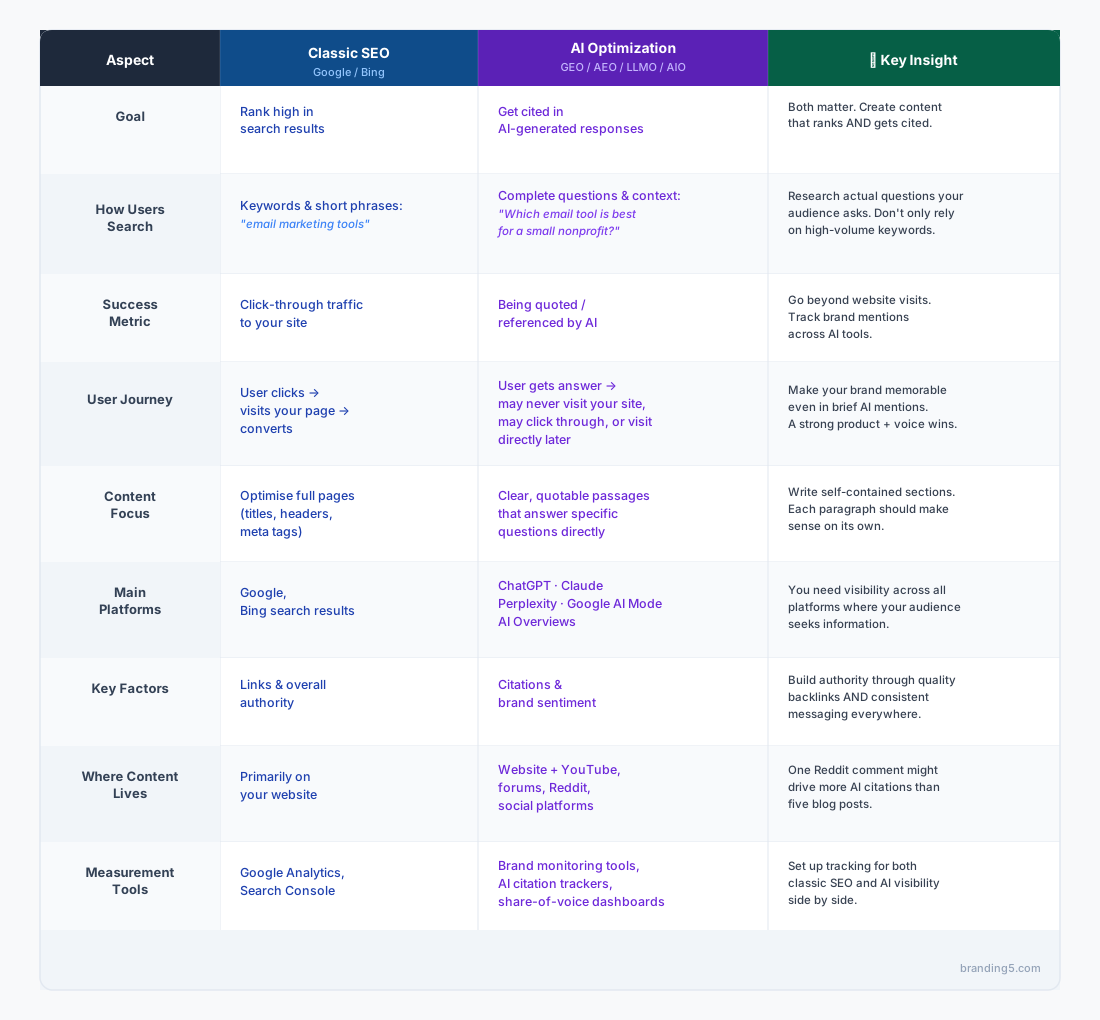
The critical insight: you don't choose between these. A well-positioned, well-structured piece of content performs across both traditional search and AI systems. The investments are additive, not competing.
How to Explain This to Your Boss Without Triggering Panic
Your leadership team will hear "SEO is changing" and immediately think "we're losing traffic." Here's how to reframe it.
Don't lead with the acronyms. Your CMO doesn't care whether it's GEO or AEO. They care whether your brand is visible when customers are making decisions.
Lead with the customer journey shift: "Our customers are increasingly getting answers from AI systems before they ever hit a search results page. We need to be part of those answers, not invisible in them."
Anchor to what's already working: Every investment in content quality, brand authority, and consistent messaging already serves both traditional SEO and AI visibility. You're not replacing your strategy. You're extending it.
Set honest expectations: Nobody has a perfect read on how every AI engine weights sources. The factors that are proven (authority, relevance, clarity, entity consistency) are the same factors that drove good SEO results for years. Optimize those and you're ahead of the curve on both fronts.
Offer a concrete next step: Audit your top 20 pieces of content. Ask: "Could an AI system extract a clear, accurate, quotable answer about our product/service from this page?" If the answer is no, that's your roadmap.
The Brand Positioning Foundation Everything Else Rests On
Here's the uncomfortable truth beneath all the acronym noise: most brands aren't losing AI visibility because of technical SEO issues. They're losing it because their brand positioning is unclear.
When your ICP, your differentiation, your tone of voice, and your messaging are all precisely defined and consistently expressed across your website, your content, your social presence, and your press mentions, AI systems build an accurate, positive model of who you are. You become the entity that gets cited when someone asks about your category.
When your positioning is fuzzy (when your homepage says one thing, your blog says another, and your LinkedIn says a third) AI builds a fuzzy model. And fuzzy brands don't get recommended.
This is the work that has to happen before you optimize a single meta tag for AI: Know exactly who you are, who you're for, and why anyone should choose you. Then express that with relentless consistency, everywhere.
That clarity is what Branding5 is built to give you. Feed it your business, your audience, and your URL, and in about 30 minutes you get a complete brand strategy: ICPs, brand archetype, competitor positioning, a differentiated positioning statement, and ready-to-use messaging. The output is designed to be deployed directly to your website, your content calendar, and your sales deck, the exact assets that feed AI's model of your brand.
The Bottom Line
The SEO vs. GEO debate is mostly noise. The signal is this:
- AI is now part of the customer journey. More people are getting answers from ChatGPT, Perplexity, and Google AI Mode than ever before, often before they search at all.
- The fundamentals don't change. Authority, clarity, relevance, and trust still determine who gets cited.
- Brand positioning is the new competitive moat. The brands with precise, consistent, differentiated positioning are the ones AI reaches for when it synthesizes an answer.
- The work is additive, not replacing. Every investment in brand clarity and content quality pays off in both traditional search rankings and AI visibility.
Stop chasing the acronym of the month. Nail your positioning, structure your content for direct answers, build authority in the places your customers actually are, and you'll win regardless of what search evolves into next.
Ready to give AI a clear, accurate story to tell about your brand?
Get your complete AI brand positioning report (ICPs, archetype, competitor map, positioning statement, and ready-to-ship messaging) in about 30 minutes.